
A light-powered artificial intelligence chip threatens Nvidia's dominance Much higher speeds and lower hea
A light-powered artificial intelligence chip threatens Nvidia's dominance Much higher speeds and lower hea
NEWSTECHNOLOGY & CRYPTOOTHER NEWS
1/29/20262 min read
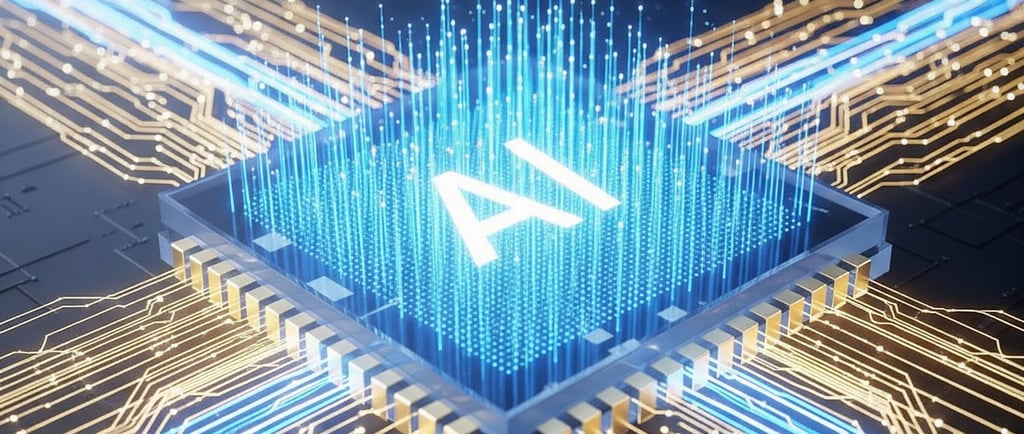

The Light-Speed Shift: How a Light-Powered AI Chip Could End Nvidia’s Reign
In the high-stakes world of artificial intelligence, Nvidia has long been the undisputed king. Its H100 and Blackwell GPUs are the engines of the generative AI revolution, but they share a fundamental weakness: they run on electricity. As AI models grow, they are hitting a "power wall"—consuming massive amounts of energy and generating heat that threatens to destabilize global power grids.
Enter Neurophos, a US-based startup backed by Bill Gates’ Gates Frontier Fund. The company has unveiled a radical new processor that doesn't use electrons to think. Instead, it uses photons—light.
The Core Breakthrough: Computing at 56 GHz
The Neurophos approach replaces traditional electronic transistors with "metasurface modulators." These components are roughly 10,000 times smaller than traditional silicon photonics parts. This miniaturization allows the company to pack a single, massive optical tensor core onto a chip—a 1,000-by-1,000 matrix that is 15 times larger than the cores found in most AI GPUs.
Because the chip operates using light passing through metamaterials, it can achieve speeds that sound like science fiction:
Speed: The OPU (Optical Processing Unit) operates at a clock frequency of 56 GHz. For comparison, Nvidia’s flagship RTX 6000 boost clock is around 2.6 GHz.
Heat: Because photons do not experience resistance in the same way electrons do, the chip generates almost no heat during the actual computation.
Efficiency: Neurophos claims its first-generation chip, the Tulkas T100, can deliver up to 100x the energy efficiency of current leading GPUs.
Why This Threatens Nvidia
Nvidia’s dominance is built on the efficiency of its CUDA software stack and its ability to scale silicon performance. However, traditional silicon is governed by Moore's Law, which is slowing down. To get more power, Nvidia has to pack more transistors into a chip, which consumes more electricity and creates more heat.
Neurophos bypasses this entirely. By using a "Compute-In-Memory" (CIM) architecture, the chip eliminates the "von Neumann bottleneck"—the energy-intensive process of moving data between the processor and memory. In a Neurophos chip, the computation is the light passing through the memory array.
Comparison at a Glance
Feature
Traditional GPU (e.g., Nvidia H100/Blackwell)
Neurophos Tulkas T100 OPU
Medium
Electricity (Electrons)
Light (Photons)
Clock Speed
~2.5 - 3.0 GHz
56 GHz
Performance
High, but heat-limited
10x - 100x higher throughput
Power Draw
Significant (700W+ per chip)
Minimal for compute; 1-2kW for the full tray
Scaling
Limited by thermal/power walls
Scales with optical parallelism
The Road to 2028
While the technology is revolutionary, Nvidia isn't going anywhere just yet. Neurophos recently closed a $110 million Series A funding round to move from proof-of-concept to mass production. The company expects its chips to begin shipping around 2028.
Initially, these light-powered chips will likely serve as "drop-in replacements" for specific AI tasks, such as the compute-intensive "prefill" phase of Large Language Models. If Neurophos can deliver on its promise of "Exaflop-scale" computing in a single rack, the era of the electricity-hungry GPU may finally be coming to an end.
As Neurophos CEO Patrick Bowen put it: "Moore's Law is slowing, but AI can’t afford to wait." By switching to light, the industry may have found the only way to keep the AI dream alive without burning out the planet.