
Hyundai shares fall after Trump says tariffs on South Korean autos, pharma to rise to 25%
OTHER NEWSNEWS
1/27/20262 min read
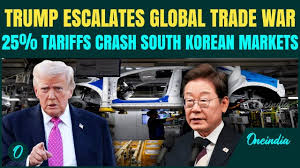
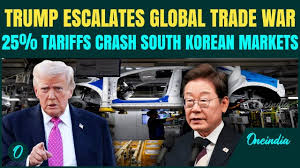
Market Impact Report: Trump's 25% Tariff Hike on South Korean Imports
Date: January 27, 2026
Subject: Market reaction to the U.S. tariff increase on South Korean automobiles, pharmaceuticals, and lumber.
1. Overview of the Announcement
On Monday, January 26, 2026, U.S. President Donald Trump announced via social media that he would increase reciprocal tariffs on South Korean imports from 15% to 25%.
The President cited the South Korean National Assembly’s failure to enact the "Historic Trade Agreement" (initially reached in July 2025 and reaffirmed in October 2025) as the primary reason for the escalation. The hike specifically targets:
Automobiles and Auto Parts
Pharmaceuticals
Lumber
General Reciprocal Goods
2. Market Reaction: Hyundai and Kia
Hyundai Motor Group, the largest exporter of South Korean vehicles to the U.S., saw immediate negative pressure on its share price during early Tuesday trading in Seoul.
Hyundai Motor (005380.KS): Shares fell as much as 5% in morning trade, eventually settling around a 3.55% loss in early sessions. This represents a significant reversal after the stock hit record highs earlier in the month following previous tariff de-escalations.
Kia Corp (00270.KS): Hyundai's sister company experienced an even sharper decline, falling nearly 4.9%.
Sector Impact: The auto sector is particularly vulnerable because the U.S. is its most profitable market. Analysts estimate that a 25% tariff could cost the Hyundai-Kia group over 5 trillion won (approx. $3.7 billion) in annual customs duties if sustained.
3. Broader Economic Fallout
The announcement sent shockwaves through the South Korean financial markets beyond just the automotive sector.
KOSPI Index: The benchmark South Korean index fell 0.84% (41.39 points) to 4,908.20 shortly after the market opened.
Currency (KRW): The Korean Won weakened significantly, opening at 1,450 KRW per USD, a drop of roughly 9.4 won from the previous session.
Pharmaceuticals: Major biotech firms also saw declines, with Samsung Biologics falling 0.5% and Celltrion dropping 2.79% in early trade.
Trade Minister Response: South Korean Trade Minister Kim Jung-kwan is reportedly traveling to Washington to initiate urgent talks with U.S. Commerce Secretary Howard Lutnick to mitigate the hike.
4. Strategic Outlook for Hyundai
Hyundai has previously implemented several strategies to buffer against tariff volatility:
Assurance Program: In April 2025, Hyundai launched an "Assurance Program" to absorb some tariff costs and keep consumer prices stable.
U.S. Localization: The company is accelerating production at the Hyundai Motor Group Metaplant America (HMGMA) in Georgia to shift more manufacturing onto U.S. soil, thereby bypassing import duties.
Negotiation Leverage: Some market analysts suggest Trump’s move may be a "pressure tactic" to force the South Korean legislature to ratify the trade deal quickly, leaving a slim hope that the 25% rate might be walked back if Seoul complies.
5. Summary Table
Asset Change (Approx.) Key Driver Hyundai Motor
-3.55% to -5.0% High export exposure to 25% U.S. tariffs.
Kia Corp -4.90% Heavier reliance on imported inventory vs. U.S. builds.
KOSPI -0.84% Broad risk-off sentiment in Seoul.
USD/KRW +0.65% (1,450) Flight to safety; concerns over trade balance.
Samsung Biologics -0.50% Direct mention of Pharma in tariff list.